


From 6 April, the exhibition “History and the artist: Julija Daniliauskienė” from the Šiauliai “Aušra” Museum is on display at the National Museum of Lithuania, in the New Arsenal (Arsenalo St. 1). On 4 May at 4 p.m. the exhibition and the catalogue-album “Julija Daniliauskienė: being in papercuts”, published by the Šiauliai “Aušra” Museum, will be presented.
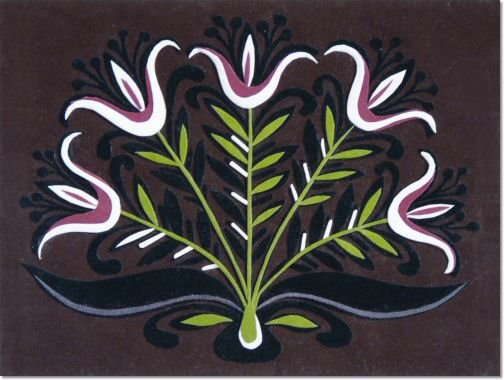
Julija Daniliauskienė (1926-2009) was a folk artist, an internationally recognised master of paper cutting and a friend of the Šiauliai “Aušra” Museum. Her name is associated with the flourishing of papercutting – a form of creative work that had been half-forgotten, yet was greatly loved in Lithuanian daily life in the 19th and early 20th centuries. In 2008 J. Daniliauskienė donated the greater part of her creative legacy (1,556 papercuts) to the “Aušra” Museum. Her works are also held in other museums in Lithuania and abroad: the National Museum of Lithuania, the Lithuanian Art Museum, the M. K. Čiurlionis National Museum of Art, the Kelmė Regional Museum, the Domodedovo Museum of History and Art (Domodedovo, Russia) and the Russian State Museum of Ethnography (St Petersburg, Russia).
J. Daniliauskienė was born into the family of Darija Zubovaitė and Stasys Pūtvis in Šilo Pavėžupis (Kelmė district), which she called the paradise of her childhood. After the Soviets occupied Lithuania in June 1940, S. Pūtvis was arrested as early as 12 July and imprisoned in Šiauliai prison. When the Second World War began, in June 1941 he was deported to Russia together with other political prisoners. He died on 4 April 1942 in Gorky prison. On 14 June 1941 D. Zubovaitė-Pūtvienė was deported with her daughters Julija and Aleksandra and her son Rymantas to the Altai Krai, and in 1942 to the island of Muostakh in the delta of the Lena. In 1947 the Pūtvys family was allowed to move to Yakutsk. Only in 1956 did they return to Lithuania.
In 2008 Julija Pūtvytė-Daniliauskienė handed over to the Šiauliai “Aušra” Museum the epistolary legacy of the Pūtvys family’s exile – letters written in exile and to those in exile by Darija Zubovaitė-Pūtvienė, Julija and Aleksandra Pūtvytė and Tatjana Zubovienė. Especially moving are the letters of Julija and Aleksandra Pūtvytė, written in the 1940s in the cold land of Yakutia, when the family had been deported to the Laptev Sea and dispersed among different places: Tiksi, Kyusyur, Arangastakh and Bykov. The letters, mostly written to their mother D. Zubovaitė-Pūtvienė, were passed from hand to hand and placed on the barges that came to collect fish – the only link with the outside world.
J. Daniliauskienė spent fifteen of the finest years of her youth in Siberia. She returned to Lithuania with three daughters and with her husband of the same fate, the ethnographer Antanas Daniliauskas (1926-1983), who supported her work all his life and contributed to the revival and popularisation of Lithuanian paper cutting. In 1967 J. Daniliauskienė joined the Folk Art Society (from 1990 the Lithuanian Folk Artists’ Union). From 1958 the artist took part in folk art exhibitions in Lithuania and beyond. She held her first solo exhibition of paper cuttings in 1964. In all, more than 40 solo exhibitions were held. In 1979 her work was recognised with the national Paulius Galaunė Prize.
J. Daniliauskienė’s papercuts are a distinctive variety of present-day folk art graphics. The main sources of her work – folk art, nature and a sensitive artistic nature – merged into a whole and revealed her mastery of artistic technique, her creativity and inventiveness. From a single artistic sign or segment of ornament the artist developed the art of papercutting into the most complex compositions and decorative graphic sheets. J. Daniliauskienė remained an optimist, although she did not shy away from sterner subjects or monumental expression. Her papercuts are dominated by vital plant motifs and abstracted geometric compositions with the features of signs and symbols. Her works are marked by clarity of style and harmony.
The artist was constantly moved by the variety and beauty of Lithuanian nature. Trees, plants, birds and animals are among the most important motifs of her work. The papercuts displayed in this exhibition make it possible to trace the artist’s consistent progression from the repetition of the motifs of the nature around her (“Meadow grasses”, 1966) and her early appliqués (the four-work cycle “The Seasons”, 1960) to stylised plant works (the cycle “Oh forest, green little forest, full of small birds”, “Festive hymn”, 1975) and complex abstracted compositions (the cycles “Sash motifs”, “Rhythms”, 1985-1991, “Memory”, 1989-1990), based on plant and geometric ornaments and their rhythmic repetition.
According to the art historian Irena Kostkevičiūtė, “in J. Daniliauskienė’s papercuts, as in our folk songs, the poetry of nature is expressed, the true music of ornament rings out, and there flows a pure, inexhaustible play of decorative form that gives a person an innate and practically disinterested aesthetic delight”.
The publication “Julija Daniliauskienė: being in papercuts”, consisting of an album and a catalogue, presents the folk artist’s creative legacy held at the Šiauliai “Aušra” Museum. It introduces J. Daniliauskienė’s personality, reviews her work and provides a bibliography. The album is illustrated with the artistically most valuable papercuts, reflecting the sources of the papercutting master’s work – folk art, nature and a sensitive artistic nature. The catalogue provides descriptions of the works held at the Šiauliai “Aušra” Museum. The publication is intended for everyone interested in traditional Lithuanian art, culture and history. The publication of the catalogue-album was supported by the Ministry of Culture of the Republic of Lithuania and the Lithuanian Council for Culture.